|
|
Does Your Legislature Believe in Self-Governance? Part 1: 2015 - 2019 August 18, 2026 |
|
|
In a REPUBLIC, We the People ARE the government. There should be no “them vs us” mentality.
Government is not a “they” separate from “us,” but an “it,” an entity comprised OF us, created and controlled BY us, FOR the benefit of all.
This is what distinguishes America and Americans from all other world countries and peoples, past or present.
We should never be ruled from above by “The Man.” On the contrary, it is our prerogative and our duty to self-govern.
We establish centralized governmental agencies and structure to do the minimal things it makes sense for them to do, or that we cannot do for ourselves. That’s ALL.
We elect representatives to act on our behalf, and we control their behavior through communication and elections—directly and democratically.
The framers of the U.S. Constitution, reflecting the very real concerns of the former colonists, were opposed to a centralized government with too much power. Thus, they created the framework for the American Republic to be as different as possible from what they had suffered under the British Monarchy.
The Constitution enumerated only six reasons we need government, all of which are goals we cannot effectively accomplish by or for ourselves:
Furthermore, the first 10 Amendments (Bill or Rights) lists powerful limitations on the federal government. Together, the Constitution and the Bill of Rights comprise a document that
1. enumerates what the federal government can/must do 2. specifies that it has no power to do anything beyond those enumerated items 3. specifically hands all other rights to the states and the People.
By specifying that each state must guarantee its citizens a “republican form of government,” it decrees that the powers of the state governments must also work within the limits of the demands of those 6 responsibilities.
In the states, then, all other powers devolve to THE PEOPLE, who are responsible to self-govern.
This concept has completely eluded the California State Legislature and recent Governors.
To the contrary, they have been on a power-grabbing crusade to wrest from the hands of We the People any and all ability to self-govern or to exercise our right of control over the centralized government.
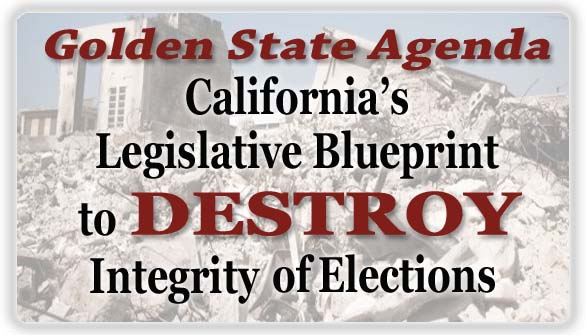
In recent years, the California legislature has mined the road to self-governance with serious and destructive roadside bombs designed to eliminate, or at least discourage, the most basic efforts of We the People—recalls and initiatives.
ROADSIDE BOMB NUMBER 1: In 2015, California passed AB 952, mandating that council members appointed to fill vacancies remain in office until the next regular election.
When an office becomes vacant, it is good to have a person appointed to fill the position TEMPORARILY, but ALL offices belong to the People, and it is OUR right to determine who fills those offices.
Eliminating special elections to fill vacancies removes the power of the People to be governed by individuals of their choice, and solidifies the power of the official(s) making the appointments.
This bill allows the hand of the State to reach into the governmental positions closest to the People, our Councils, and remove our right to be governed by those WE choose.
It acts as a deterrent to any recall efforts, which now becomes a way to shoot ourselves in the foot.
ROADSIDE BOMB NUMBER 2: Also in 2015, California passed AB 1100, increasing the filing fee for a proposed ballot initiative or referendum from $100 to $1,000—a ten-fold increase!
While the bill provides potential discouragement to file frivolous or nonsense initiatives or referenda, it also begins the process of making self-governance through direct democracy more difficult and costly.
ROADSIDE BOMB NUMBER 3: In 2016, CA passed AB 278 and AB 2220, both of which extend permission to the legislative body of a city to adopt an ordinance that requires district rather than at-large representation without seeking voter approval.
This policy encourages “balkanization” and division, causing citizens of the same city to focus on their differences rather than their commonalities. It begins to crumble the concept of “one nation…indivisible.”
Allowing this type of decision to be made without voter approval usurps power that rightly belongs only to the People.
ROADSIDE BOMB NUMBER 4: Also in 2016, California passed AB 2389, allowing the governing body of a special district to require, by resolution, that its members be elected by district rather than at-large representation without seeking voter approval.
This bill extends the agenda to remove self-governance begun with AB 278 and 2220.
ROADSIDE BOMB NUMBER 5: In 2019, California passed SB 681, authorizing a proponent of a municipal or district referendum to withdraw the referendum up to 88 days before the election even if the referendum has qualified for the ballot.
This law runs the risk of removing the choice of all signers of the referendum’s petition, and opens up the potential of undue influence or pressure on a proponent to scuttle a legitimate act of self-governance for all proponents and signers.
=======
2014-2019 was a “good start” for this legislative agenda. Part 2 of this article will chronicle its continuance through 2025.
Click here to post on your social media. |